

Posted by Michele Priest on Aug 5th 2026
How to Read Your Consumer Confidence Report
What Your Annual Water Quality Report Really Means
Every year, thousands of water utilities across the United States publish a Consumer Confidence Report (CCR), sometimes called an Annual Water Quality Report. Yet many homeowners never read it, and many who do aren't sure what the numbers mean.
Your CCR is one of the best tools available for learning about your community's drinking water. It provides valuable information about where your water comes from, what contaminants were detected, and whether your utility met federal drinking water standards.
However, it is important to understand both what the report tells you, and what it doesn't.
Knowing how to read your CCR can help you make informed decisions about the water your family drinks every day.
What Is a Consumer Confidence Report?
Since 1999, the EPA has required community water systems to provide customers with an annual Water Quality Report under the Safe Drinking Water Act.
The purpose is simple: to give consumers clear information about the quality of their drinking water.
Most reports include:
- The source of your drinking
- A summary of contaminants detected during required testing
- The levels detected
- The EPA's Maximum Contaminant Level (MCL), when applicable
- Whether the water system complied with federal drinking water regulations
- Educational information about drinking water and potential health risks
Many utilities mail the report each year, while others provide it electronically on their website.
Why Your Consumer Confidence Report Matters
The report helps answer important questions, including:
- Where does my water come from?
- Were any contaminants found?
- Did my utility meet federal safety standards?
- Are there any ongoing concerns I should know about?
The report also provides transparency by allowing consumers to see the results of required monitoring instead of simply assuming the water is safe.

How to Read Your Consumer Confidence Report
Most reports follow a similar format:
1. The Water Source – Where your water originates
This may include:
-
- Rivers
- Lakes
- Reservoirs
- Groundwater wells
- Aquifers
Understanding the source helps explain which contaminants may naturally occur or enter the water before treatment.
2. Contaminant Table
The contaminant table is usually the longest section of the report. For each regulated contaminant, you'll typically see:
-
- The contaminant name
- The amount detected
- The legal limit (Maximum Contaminant Level or MCL – set by EPA)
- The EPA's health goal (Maximum Contaminant Level Goal or MCLG), when applicable
- Whether the utility met federal standards
Seeing a contaminant listed does not automatically mean the water is unsafe. Many naturally occurring minerals and other substances are commonly found in drinking water at levels below EPA standards.
3. Understand the Units
The reports will often use measurements such as:
-
- ppm (parts per million)
- ppb (parts per billion)
- ppt (parts per trillion)
- pCi/L (picocuries per liter for radioactive contaminants)
These extremely small measurements allow laboratories to detect contaminants at very low concentrations.
4. Health Information
These sections help explain why some contaminants may pose greater risks for certain groups, even when water meets regulatory standards.
-
- Infants
- Pregnant women
- Older adults
- Individuals with weakened immune systems
5. Violations
If your utility exceeded an EPA standard for a contaminant, or failed required monitoring, the report must explain:
-
- What happened
- When it occurred
- Possible health effects
- Corrective actions being taken
Most community water systems remain in compliance with federal standards but reading this section each year helps you stay informed.
What Your Consumer Confidence Report Doesn't Tell You
This is where many consumers misunderstand what these reports are designed to do. A CCR is not a complete inventory of everything that could be present in your drinking water. Instead, it summarizes testing that federal regulations require water systems to perform.
That means some substances may not appear in your report for several reasons.
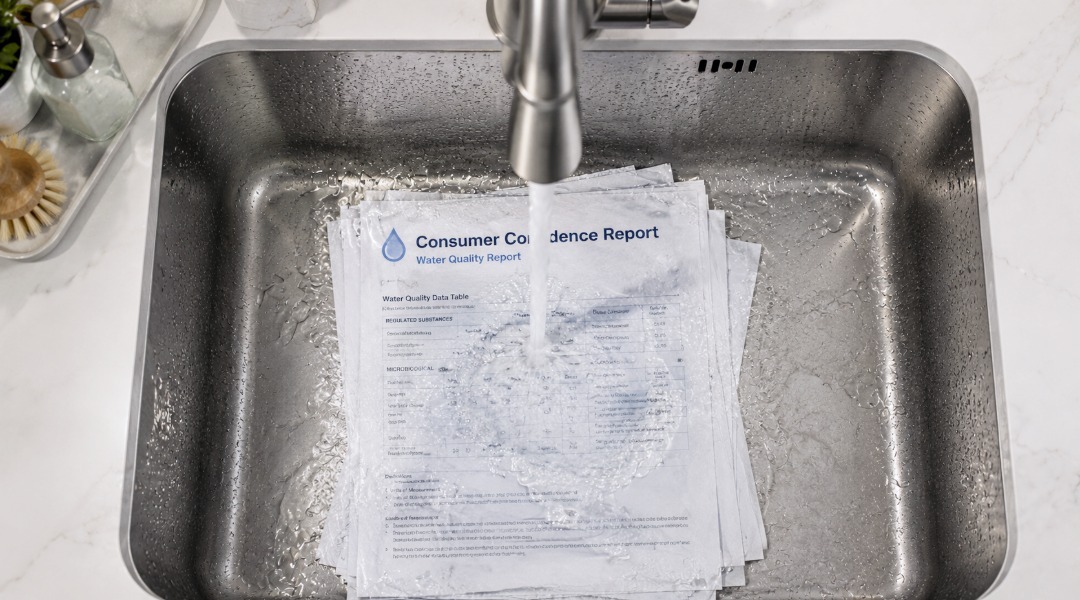
Consumer Confidence Report vs. What's Actually Coming Out of Your Tap
A CCR provides an overview of the quality of water delivered by your community water system. While it offers valuable information, it does not necessarily reflect the exact quality of the water coming out of the faucet.
Once treated water leaves the utility, it travels through miles of distribution pipes before reaching homes and businesses. Along the way, water quality can be affected by the condition of aging water mains, service lines, and even the plumbing inside individual homes.
For example, lead and copper are often introduced into drinking water after it leaves the treatment plant through corrosion of older plumbing materials, solder, fixtures, or lead service lines. This is why the reports include information about lead, even when the source water itself contains little or no lead.
In addition, the results shown are based on monitoring conducted according to EPA regulations. Water quality can vary based on location within the distribution system and normal changes over time, and utilities are not required to test every tap or every home in their service area.
This doesn't mean your annual report is inaccurate. Rather, it serves a different purpose. It provides a snapshot of your community water system's compliance.
If you have concerns about the water in your own home, particularly if you live in an older house, have aging plumbing, or notice changes in the taste, odor, or appearance of your water, you may wish to contact your water utility or have your tap water tested. Understanding both your Consumer Confidence Report and the conditions within your home's plumbing can provide a more complete picture of your drinking water quality.
Not Every Contaminant Is Federally Regulated
Scientists continue discovering and studying contaminants that may affect drinking water. Some substances are still being researched and are not yet subject to national drinking water standards. Because utilities generally report contaminants required under federal regulations, these emerging contaminants may not appear in your annual report.
Examples include certain:
- PFAS compounds that are becoming subject to new EPA drinking water regulations and may begin appearing in Consumer Confidence Reports over the coming years (aka forever chemicals).
- Pharmaceuticals
- Microplastics
- Some industrial chemicals
- Newly identified contaminants under scientific evaluation
As research evolves, EPA periodically evaluates whether additional contaminants should be regulated.
Testing Frequency Varies
Monitoring frequency varies depending on the contaminant and EPA requirements. Some contaminants are monitored several times throughout the year, while others may only be sampled every few years. If no recent testing was required, your report may include results from previous monitoring periods.
Water Quality Can Change After It Leaves the Treatment Plant
Consumer Confidence Reports primarily reflect the quality of water delivered by the public water system.
However, water can encounter additional issues as it travels through aging infrastructure or household plumbing. This is why in 1991the EPA established the Lead and Copper Rule. This rule was developed to reduce exposure to lead and copper, with particular emphasis on protecting infants and young children.
*EPA's Lead and Copper Rule has undergone revisions over time.
See EPA guidance for the most current requirements.
Because lead usually enters drinking water through corrosion of plumbing materials rather than from the source water itself, EPA regulations require water systems to monitor for lead at high-risk homes instead of at the treatment plant.
That's one reason the report includes educational information about lead and recommends testing tap water in homes with older plumbing if there is concern.
Private Wells Do Not Receive Consumer Confidence Reports
If your home uses a private well, you will not receive a report because private wells are not regulated under the Safe Drinking Water Act.
Understanding the Purpose and the Limitations
The Consumer Confidence Report serves an important public health purpose.
It helps consumers understand:
- Where their water comes from
- Whether their water utility complies with federal regulations
- What contaminants were detected during required monitoring in the previous year
The report was never intended to certify that drinking water is completely free of every contaminant.
It is a regulatory compliance document, not a guarantee that every possible substance has been tested or that every home receives identical water quality.
Understanding this distinction helps consumers use the report appropriately: as a valuable source of information rather than a complete picture of everything that may be present in drinking water.
What Should You Do After Reading Your Report?
After reviewing your Consumer Confidence Report, consider these questions:
- Were any contaminants detected?
- Were all results below federal standards?
- Has anything changed from previous years?
- Does your home have older plumbing that could contribute lead or copper?
- Do you want additional information beyond what the annual report provides?
If you have questions, contact your local water utility.

Considering Additional Water Protection?
Your Consumer Confidence Report provides valuable information about your community's drinking water, but it may also leave you with questions about contaminants that aren't included in the report or about the quality of the water at your own tap.
If you want an additional layer of protection, look for a water filtration system that has been independently tested and certified by NSF. NSF certification verifies that a product has been evaluated against established standards and has been tested to reduce specific contaminants identified in its certification.
NSF certifications are specific to individual contaminants and standards. Before purchasing any water filter, review the manufacturer's certification documentation to verify exactly which contaminants the product has been tested and certified to reduce.
Choosing a filter based on independent certification not marketing claims helps ensure you're selecting a product that has been verified to perform as advertised.
The Bottom Line
Your Consumer Confidence Report is one of the most valuable resources available for understanding your community's drinking water.
Just remember that the report has a specific purpose. It is designed to communicate compliance with drinking water regulations, not to provide a complete list of every contaminant that could potentially be present.
Your Consumer Confidence Report is an excellent starting point for understanding your community's drinking water. By learning what the report includes, and recognizing what it doesn't, you'll be better equipped to make informed decisions about the water your family uses every day.
FAQs
Does finding contaminants mean my water is unsafe?
Why aren't PFAS or other emerging contaminants listed?
Is my tap water tested every day?
Where can I find my Consumer Confidence Report?
Sources & Further Reading
U.S. Environmental Protection Agency (EPA)
Centers for Disease Control and Prevention (CDC)